Every nutrition app in the App Store calls itself free. Almost none of them are free in the way you assume when you tap the download button. You get the app, you get a few days of unrestricted use, and then you hit a wall somewhere between logging your third meal and checking last week's average.
This is not a criticism. Building and maintaining a food database costs real money, and the alternative to subscriptions is usually advertising or selling your data, both of which are worse. But it does mean that "free protein tracker app" is a search that deserves a straight answer rather than a listicle. Below is what the free tier of a protein tracking app typically includes, what it almost never includes, and how to work out whether the free version will actually get you where you want to go.
What "Free" Usually Means in a Protein Tracking App
There are four common models, and they behave very differently once you have been using the app for a month.
Free with a logging cap. You can log a limited number of entries per day or per week. This is the model Protein Tracker uses: the free tier allows one protein log per day. It sounds restrictive, and for someone eating five times a day it is. But it is honest in a way that a seven-day trial is not, because the limitation is visible from day one rather than arriving as a surprise on the day your card gets charged.
Free trial, then subscription. You get everything for three to seven days, then the app locks almost entirely. These are the apps people mean when they complain that nothing is free anymore. The trial length is usually calibrated to be just long enough for you to build a habit and just short enough that you have not yet decided whether the app is any good.
Free with ads. Fully functional, interrupted by video ads between screens. Workable if you have patience, and genuinely free. The trade-off is that ad-supported nutrition apps have a strong incentive to keep you tapping around inside the app, which is the opposite of what a good tracker should do.
Free tier, paid extras. Core logging is unlimited and free forever; advanced features like photo recognition, custom foods, or detailed exports sit behind a purchase. This is the friendliest model for someone who just wants to count grams.
Knowing which model you are in matters more than any feature comparison, because it determines whether the app will still be usable in week three.
The Features That Are Almost Always Free
Across essentially every protein tracker worth installing, these come at no cost:
- A daily protein target. Most apps will calculate one from your body weight, activity level, and goal. Some let you set it manually.
- A basic food database. Usually a few hundred to a few thousand common foods with protein values per standard serving.
- A daily total. The number of grams you have logged today, against your goal.
- Some form of progress visual. A ring, a bar, a percentage.
If an app charges for any of the above, close it. That is the baseline, not a premium feature.
The Features That Are Almost Always Paid
Here is where the paywalls tend to sit, and why:
Unlimited logging. The single most common restriction. Free tiers cap entries because logging is the core value of the product.
Editing past entries. You realise on Thursday that Tuesday's chicken was 200g, not 150g. Fixing it is frequently a paid feature, which is frustrating but at least easy to work around if you catch mistakes the same day.
Custom foods. Adding your own recipes, your specific brand of protein powder, or the exact yogurt you buy. Free databases skew toward generic entries, so if you eat the same five branded products constantly, custom foods matter a lot more than they sound.
Photo or AI-based estimation. Photographing a plate and getting a protein estimate back requires running a vision model on someone's server, which costs money per request. Protein Tracker's AI Meal Scan sits behind Pro for exactly this reason. Treat any photo estimate, paid or free, as an approximation rather than a measurement.
History beyond a few days and data export. Weekly and monthly averages are often gated, which is unfortunate, because the weekly average is the number that actually predicts results.
Can You Reach Your Goal on a Free Tier Alone?
Genuinely, yes, for a large number of people. It depends on why you are tracking.
If you are tracking to learn, a free tier is plenty. Most people have no idea what their protein intake looks like. They guess 120 grams and they are eating 65. Two weeks of tracking fixes that permanently, and two weeks is well within what any free tier can handle. Once you know that your standard breakfast is 12 grams and your standard lunch is 30, you can do the arithmetic in your head indefinitely. Tracking is a measuring instrument, not a lifestyle.
If you eat the same things most days, a free tier is plenty. A capped logging tier is only painful if every meal is novel. If you rotate through eight or ten meals, you learn their values in a week and only need to log the unusual ones.
If you are in an active building or cutting phase, pay for the app. When you are trying to gain muscle at a specific rate or preserve it in a deficit, the difference between 140 and 165 grams a day is the difference between the plan working and not working. A one-time lifetime purchase in the region of thirty dollars is a rounding error next to what you are spending on food, and hitting the target consistently is the entire point of the exercise.
If tracking makes you anxious, do not track at all. This deserves saying plainly. For anyone with a history of disordered eating, logging food can be actively harmful, and the free-versus-paid question is beside the point. Work with a registered dietitian instead.
How to Get the Most Out of a Free Protein Tracker
If you are staying on the free tier deliberately, a few habits make it considerably more useful.
Log your least predictable meal. If your tier gives you one entry a day, do not spend it on the breakfast you have eaten identically for two years. Spend it on dinner, or on the restaurant meal, or on whatever you genuinely cannot estimate. Use mental arithmetic for the known quantities.
Pin your favourites early. Almost every app lets you mark frequently eaten foods for one-tap logging, and this is free. Ten minutes spent pinning your regulars in week one saves you several minutes a day forever.
Batch your learning. Rather than tracking forever, track intensively for two weeks, write down what you learned, and stop. Revisit for a week whenever your diet changes meaningfully.
Weigh food for the first week only. A kitchen scale costs about fifteen dollars and will teach you more about portion sizes than any app. After a week of weighing, your eyeball estimates become dramatically more accurate, and you can put the scale away.
Round down when you are guessing. Estimation error in food logging runs consistently in one direction: people underestimate portions and overestimate protein content. Building in a small buffer means your real intake lands closer to your target than your logged intake suggests.
How Much Protein Should the Target Be?
Worth getting right before you worry about which app to use, because a perfectly tracked wrong target helps nobody.
The Recommended Dietary Allowance is 0.8 grams per kilogram of body weight per day. That figure is widely misunderstood. It is the amount required to prevent deficiency in the average sedentary adult, not the amount associated with the best outcomes for body composition, satiety, or preserving muscle as you age.
For people doing resistance training, the research supports considerably more. A frequently cited 2018 meta-analysis by Morton and colleagues found that gains in muscle mass continued to improve with higher intake up to roughly 1.6 grams per kilogram per day, after which the additional benefit became difficult to detect. Practical recommendations for active people generally land between 1.4 and 2.0 g/kg.
Older adults benefit from more than the RDA as well. Age-related muscle loss appears to be partly driven by a blunted response to dietary protein, and intakes around 1.0 to 1.2 g/kg per day are commonly recommended to help offset it.
For a 70 kg (154 lb) person, that translates roughly to:
| Situation | Grams per kg | Daily target |
|---|---|---|
| Sedentary, minimum | 0.8 | 56 g |
| General health and satiety | 1.2 | 84 g |
| Resistance training | 1.6 | 112 g |
| Fat loss with muscle preservation | 1.8–2.0 | 126–140 g |
| Adult over 65 | 1.0–1.2 | 70–84 g |
These are starting points, not prescriptions. Anyone with kidney disease, liver disease, or another condition affecting protein metabolism should get a target from their doctor rather than an app.
Distribution Matters More Than Most Apps Suggest
One thing almost no tracker handles well, free or paid: when you eat your protein appears to matter, not just how much.
Muscle protein synthesis responds to a meal in a roughly dose-dependent way up to a point, then plateaus. The practical implication is that 30 grams at each of four meals does more for muscle retention than 20 grams at breakfast and lunch followed by 80 grams at dinner, even though both add up to 120.
The typical Western eating pattern is badly skewed in exactly this direction: minimal protein at breakfast, moderate at lunch, most of the day's total at dinner. If your app shows you a single daily number and nothing else, you can miss this entirely. Look for a tracker that separates breakfast, lunch, dinner, and snacks, and glance at the split occasionally rather than only the total.
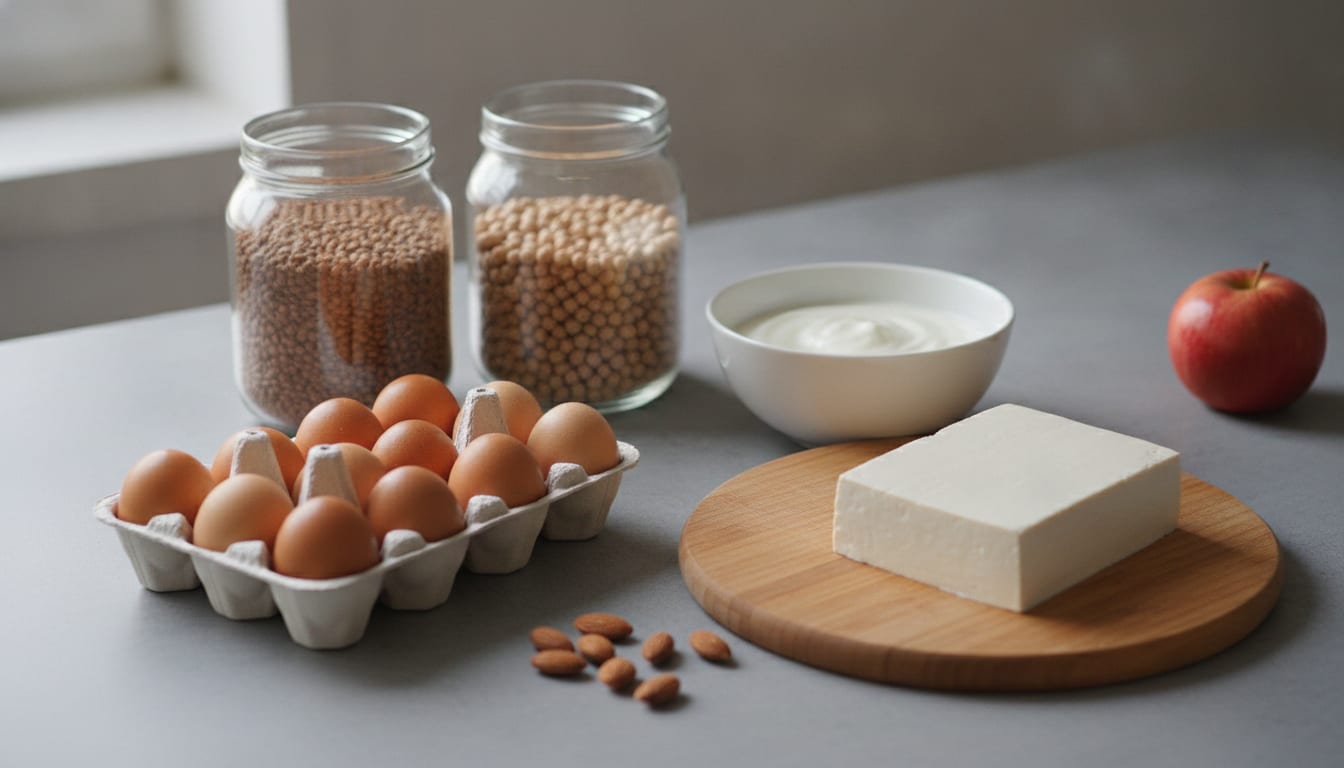
Fixing breakfast is usually the highest-leverage change available. Moving from toast and coffee to eggs, Greek yogurt, or cottage cheese adds twenty to thirty grams at the meal where most people have almost none.
High-Protein Foods Worth Memorising
If you are on a capped free tier, knowing these by heart replaces a lot of logging. Values are approximate and vary by brand and preparation.
| Food | Portion | Protein |
|---|---|---|
| Chicken breast, cooked | 100 g | ~31 g |
| Canned tuna, drained | 100 g | ~26 g |
| Salmon, cooked | 100 g | ~25 g |
| Cottage cheese | 1 cup | ~25 g |
| Whey protein | 1 scoop | ~24 g |
| Lean beef, cooked | 100 g | ~26 g |
| Greek yogurt, plain | 170 g | ~17 g |
| Firm tofu | 100 g | ~17 g |
| Lentils, cooked | 1 cup | ~18 g |
| Black beans, cooked | 1 cup | ~15 g |
| Milk | 1 cup | ~8 g |
| Egg | 1 large | ~6 g |
| Almonds | 28 g | ~6 g |
A useful shortcut: a palm-sized portion of cooked meat or fish is roughly 25 to 30 grams of protein. Most people can build an accurate day from that heuristic alone.
Frequently Asked Questions
Is there a completely free protein tracker app with no limits?
Ad-supported apps come closest, offering unlimited logging in exchange for watching video ads. Apps without ads and without limits are rare and usually short-lived, because there is no revenue to pay for the food database and servers. Most genuinely free options cap something — entries per day, history length, or the ability to add custom foods.
Is the free version of Protein Tracker enough to hit my goal?
The free tier allows one protein log per day, which is enough to learn your intake patterns and to track your least predictable meal each day. If you are actively building muscle or cutting and need reliable daily totals, Pro removes the cap and adds AI Meal Scan, custom foods, and editing of past entries. Pro is available weekly or as a one-time lifetime purchase.
Do I need to track calories as well as protein?
Not necessarily. If your goal is to eat more protein, improve satiety, or preserve muscle, tracking protein alone is simpler and far more sustainable. If your goal is a specific rate of weight change, calories become the variable that determines the outcome, and protein alone will not be enough.
How accurate are free food databases?
Generic entries for whole foods like chicken, eggs, and rice are reliable, since they come from standardised nutrition data. Crowd-sourced entries for branded and restaurant items are considerably less reliable and frequently contain errors. Prefer generic entries for whole foods and check the label for packaged items.
How long should I track protein before stopping?
Two to four weeks is enough for most people to learn what their intake actually looks like and to correct it. After that, spot-checking for a week whenever your diet or training changes is usually sufficient. Tracking indefinitely is unnecessary for most goals.
Does protein timing really matter, or is the daily total all that counts?
Total daily intake is by far the bigger factor. Distribution is a secondary optimisation that matters most when you are training seriously or trying to preserve muscle in a calorie deficit. Spreading intake across three or four meals is a reasonable target; obsessing over precise timing windows is not supported by strong evidence.
Try Protein Tracker
Protein Tracker gives you a personalised daily target, a database of over 100 high-protein foods, a progress ring that shows exactly how many grams you have left, and streaks that make consistency feel like a game rather than a chore. The free tier lets you log one entry a day, which is enough to learn where you stand.
If you decide you want unlimited logging, AI Meal Scan for photographing meals, custom foods, and the ability to edit past entries, Pro is available weekly or as a one-time lifetime purchase — no recurring commitment required.
Your logs stay on your device by default.