I have watched a lot of people download a protein tracker app. I have watched considerably fewer people still using one a month later. The gap between those two numbers is not about willpower and it is not about which app they picked. It is almost always about setup — a target that was wrong, a workflow that took too long, or an expectation that tracking had to be perfect to be worth doing.
This is a guide to the category rather than a review of any single product. What these apps actually do under the hood, which features earn their place, the specific ways people fail with them, and how to get set up in about ten minutes so that you are still using the thing in March.
What a Protein Tracker App Actually Does
Strip away the interface and a protein tracking app is doing three jobs.
It calculates a target. You provide body weight, activity level, and a goal. The app applies a coefficient — grams of protein per kilogram of body weight — and returns a number. This is simple arithmetic, and it is worth understanding because the coefficient the app chose is the single most consequential decision in the whole product, and different apps choose differently.
It looks up foods. You search "chicken breast", the app queries a database, and it returns protein per standard serving. You pick a portion and the app multiplies. Database quality varies enormously and is the main thing separating a good app from a bad one.
It adds up and compares. Today's total against today's target, displayed as a ring, bar, or number. Then it stores the result so you can see patterns over time.
Everything else — streaks, widgets, awards, AI photo scanning, insights — is built on top of those three functions. Useful, but secondary. If an app does the three basics badly, no amount of gamification saves it.
How Apps Calculate Your Target, and Why They Disagree
Install three protein trackers, enter identical information, and you will likely get three different targets. Sometimes the spread is 40 grams or more. This is not a sign that two of them are broken; it reflects genuine differences in what the underlying recommendation is trying to achieve.
The Recommended Dietary Allowance is 0.8 grams per kilogram of body weight per day. This is the figure conservative apps use, and it is frequently misread. The RDA represents the intake sufficient to prevent deficiency in nearly all healthy sedentary adults. It is a floor, not an optimum.
For people who train, the evidence supports substantially more. A well-known 2018 meta-analysis by Morton and colleagues examining resistance training studies found that improvements in lean mass continued as protein intake rose to roughly 1.6 grams per kilogram per day, with the benefit becoming hard to detect beyond that. Most sports nutrition guidance sits in the 1.4 to 2.0 g/kg range for active individuals.
Two adjustments worth knowing about:
In a calorie deficit, protein needs go up, not down. When you are eating less overall, protein is doing double duty — supporting muscle retention while your body is in a net catabolic state. Recommendations for dieting athletes often reach 2.0 to 2.4 g/kg, at the higher end for leaner individuals.
With significant excess body fat, use a corrected weight. Protein requirements track more closely with lean mass than total mass. Applying 1.8 g/kg to someone at 140 kg produces a target of 252 grams, which is neither necessary nor realistically achievable. Better apps use lean body mass or an adjusted figure; if yours does not, calculate against your target weight or roughly 1.6 g/kg of estimated lean mass instead.
If your app produces a number that seems absurd in either direction, override it. Almost every tracker allows a manual target, and a sensible number you set yourself beats a poorly derived one you did not.
Food Databases: The Part That Determines Everything
The most underrated difference between apps. There are broadly three approaches.
Curated databases are assembled and verified by the developer. Smaller — often a few hundred to a few thousand entries — but accurate. Protein Tracker takes this approach with a focused set of over 100 high-protein foods, on the reasonable theory that the foods people actually use to hit a protein target are a short list.
Crowd-sourced databases let users add entries. Enormous coverage, including obscure regional and restaurant items, but accuracy is genuinely poor. Duplicate entries, wrong serving sizes, and transposed digits are common. If you have ever seen four versions of the same yogurt with four different protein values, you have met a crowd-sourced database.
Government and institutional datasets such as the USDA's are authoritative for whole foods but weak on branded and prepared items.
The practical approach is to use generic entries for whole foods — "chicken breast, cooked" rather than a specific restaurant's chicken — and to read the label for packaged products. For anything crowd-sourced, sanity-check the number. If a bagel claims 30 grams of protein, someone entered it wrong.
Photo and AI Scanning: Useful, Within Limits
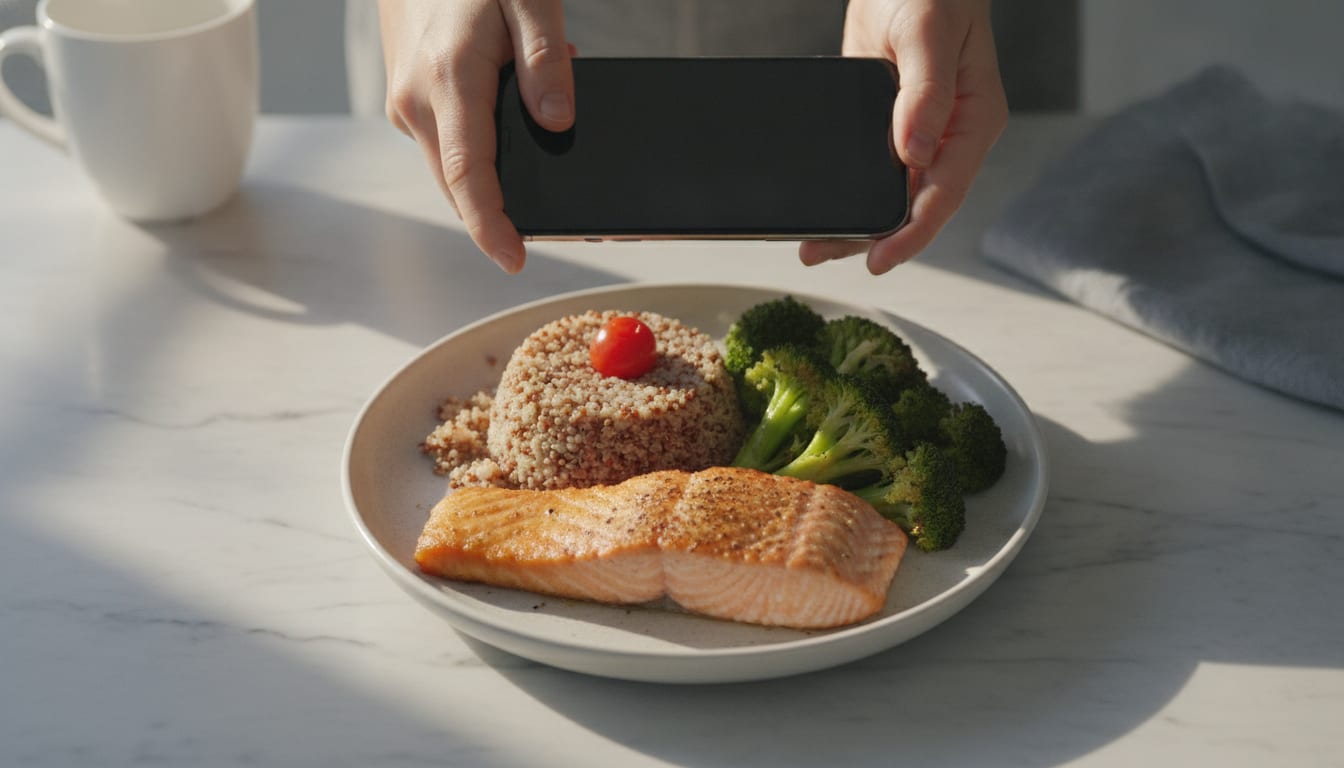
Photographing a meal and receiving a protein estimate is now standard in the better apps, Protein Tracker's AI Meal Scan among them. It genuinely helps in the situation where tracking usually breaks down: a restaurant plate, someone else's cooking, a mixed dish with no clear serving size.
Be realistic about what it can do. A vision model can identify that there is chicken on the plate and estimate its size. It cannot see the oil the chicken was cooked in, know whether the sauce is cream-based, or tell a 150-gram portion from a 200-gram one with any precision. Treat the output as a starting estimate to review and adjust, not a measurement. The apps that handle this well show you the estimate and let you correct it before logging, rather than silently committing a number.
For everyday foods you eat regularly, searching the database or tapping a pinned favourite is faster and more accurate than photographing. Save the scan for genuinely unknown meals.
The Five Reasons People Quit
In my experience coaching, abandonment nearly always traces to one of these.
The target was wrong from the start. An app assigns 210 grams a day to someone whose realistic ceiling is 140. They miss by a wide margin every single day, the ring never closes, and within two weeks the app feels like an accusation. Fix: set a target you can hit four days out of five, then raise it. A target you reach is infinitely more useful than a correct one you never approach.
Logging took too long. If a meal takes ninety seconds to record, you will stop. Fix: pin your regular foods as favourites in the first week. Logging should be one or two taps for the eighty percent of your diet that repeats.
Perfectionism. Someone misses two days, decides the data is "ruined", and deletes the app. Fix: internalise that the weekly average is the number that matters. One untracked day changes a weekly average by a few grams. It changes nothing about your results.
Tracking everything instead of just protein. Full macro tracking requires logging every component of every meal. Protein-only tracking requires logging the protein sources. This is why single-nutrient apps have better retention than comprehensive nutrition diaries — the workload is a fraction of the size. Fix: if protein is your goal, track protein.
No visible reason to continue. Without feedback, tracking feels like data entry. Fix: use the streak and the weekly average. They convert an abstract habit into something with visible momentum.
Setting Up in Ten Minutes
Concretely, here is the setup that survives.
Minute one to three: get the target right. Enter your details, look at what the app suggests, and sanity-check it. Roughly 1.6 g/kg if you train, 1.2 g/kg for general health, 1.0 to 1.2 g/kg if you are over 65. If you are more than a little overweight, calculate against target weight rather than current weight. Override the app if its number looks wrong.
Minute four to seven: pin your regulars. Search for and favourite the fifteen or so foods you actually eat — your yogurt, your protein powder, chicken breast, eggs, whatever bread you buy, your usual dinner protein. This is the step people skip and it is the step that determines whether logging takes five seconds or sixty.
Minute eight: fix breakfast. Before you log a single day, look at your usual breakfast and estimate its protein. If it is under 20 grams, that is your first change, and it is almost always the easiest twenty-gram gain available. Most people's protein distribution is heavily back-loaded toward dinner, and breakfast is where the room is.
Minute nine: turn on one reminder. A single notification at the meal you most often forget. More than one and you will start ignoring them.
Minute ten: add the widget. Putting the ring on your home screen means you see your remaining grams without opening anything. It is a small thing that meaningfully improves consistency.
Then log for fourteen days before you judge anything. Two weeks is enough to see your real pattern; two days is not.
Distribution: The Thing Most Apps Under-Communicate
Your daily total is the headline number, but how it is spread across the day is a real secondary factor, particularly if you are training.
Muscle protein synthesis responds to a protein-containing meal, rises for a few hours, and returns to baseline. The response scales with dose up to a point and then plateaus, which means a single enormous serving does not produce a proportionally larger effect. Practically, three or four meals of 30 to 40 grams each does more for muscle retention than the same total delivered as 15, 15, and 90.
Most people's actual pattern is close to that second version. Coffee and toast, a moderate lunch, then the majority of the day's protein at dinner. If your app breaks the day into breakfast, lunch, dinner, and snacks, glance at the split every so often rather than only checking the total. Evening out the distribution frequently produces better results than raising the total.
What to Look For, Briefly
If you are choosing between apps, weight your decision roughly like this:
- Logging speed for repeat foods. Favourites, recents, one-tap entry. Most important factor by a distance.
- A sensible, editable target. Both parts matter.
- Database accuracy for what you eat. Check five of your regular foods before committing.
- Meal breakdown, not just a daily total. So you can see distribution.
- Weekly averages. More informative than any single day.
- A home screen widget. Removes friction.
- Clear privacy handling. Your food log is health data. Apps that keep it on-device by default are preferable to ones that sync it somewhere unspecified.
Reasonable to ignore: extensive recipe libraries, social feeds, and anything that turns eating into a leaderboard.
Frequently Asked Questions
Do I need a protein tracker app, or can I just estimate?
Estimate accurately and you do not need an app. The problem is that most people cannot, at least at first. Studies of self-reported dietary intake consistently find substantial under-reporting, and protein specifically is easy to overestimate because it is easy to overestimate portion size. Two to four weeks of tracking calibrates your estimates, after which many people can maintain a target without logging.
Is a protein-only app better than a full macro tracker?
For a protein-specific goal, yes, primarily because you will actually keep using it. Full macro trackers require logging everything in every meal, and the workload causes most people to quit within a few weeks. If you need calorie control for a specific rate of weight change, a full tracker is the right tool. If your goal is to eat more protein, a protein tracker is the one you will still be using in three months.
How accurate does my logging need to be?
Less accurate than you think. Landing within about ten percent of your target on most days will produce essentially the same outcome as hitting it precisely. Consistency across weeks matters far more than precision on any given day.
Should I log protein before or after cooking?
Pick one and stay consistent. Cooked weights are more practical since that is what you eat, but meat loses water during cooking and therefore concentrates — 150 grams of raw chicken becomes roughly 110 grams cooked, with the same protein content. Database entries usually specify which they mean, so check.
Can I track protein without tracking calories?
Yes, and for many people it is the better approach. Protein is highly satiating, so raising intake often reduces overall calorie consumption without deliberate restriction. If you need a specific rate of weight change, you will eventually need calorie awareness too, but protein alone is a legitimate and sustainable starting point.
What if I miss a few days?
Nothing happens. Resume logging. The weekly and monthly averages are what predict results, and a couple of gaps barely move them. Treating missed days as failure is the most common reason people abandon tracking entirely, and it is worth actively resisting.
Try Protein Tracker
Protein Tracker is built around the parts that determine whether you keep tracking: a personalised target you can override, over 100 high-protein foods with one-tap favourites, a daily ring that shows remaining grams at a glance, meal-by-meal breakdown so you can see your distribution, and home screen widgets so you barely need to open the app.
The free tier lets you log one entry a day. Pro adds unlimited logging, AI Meal Scan for photographing unfamiliar meals, custom foods, and editing of past entries, available weekly or as a one-time lifetime purchase.
Your logs stay on your device by default.