Protein is the only macronutrient your body cannot store in a dedicated reserve. Fat goes into adipose tissue. Carbohydrate goes into glycogen. Protein circulates as amino acids, gets built into tissue, or is oxidised for energy — and the pool of free amino acids available at any moment is small. This is the underlying reason daily intake matters, and the reason a protein tracker is a more useful instrument than it first appears.
The term covers everything from a paper notebook to an app that photographs your dinner. What they share is a single function: converting an intention you cannot verify — "I should eat more protein" — into a number you can check. This guide covers what the research supports on how much you need, why the timing of that intake is not irrelevant, how protein quality changes the arithmetic, and how to use a tracker as a temporary measuring device rather than a permanent obligation.
What a Protein Tracker Is For
The case for tracking rests on a well-documented finding: people are poor estimators of their own dietary intake. Studies comparing self-reported food intake against objective measures such as doubly labelled water consistently find substantial under-reporting, frequently in the range of twenty to thirty percent, and the error is not random. It correlates with body weight, with social desirability, and with how much attention the person was paying.
For protein specifically, the error tends to run in a particular direction. People overestimate how much protein a given food contains and underestimate how much food they need to reach a target. A person who believes they eat 130 grams a day is often closer to 85. The gap is invisible without measurement, which is precisely what a tracker provides.
What a tracker is not is a permanent lifestyle. The useful output is calibration — after two to four weeks, you know what your breakfast is worth, what your standard dinner is worth, and where your gaps are. That knowledge persists after you stop logging.
How Much Protein: What the Evidence Supports
The Recommended Dietary Allowance for protein is 0.8 grams per kilogram of body weight per day. This figure is the source of most confusion in the area, so it is worth being precise about what it means.
The RDA is derived from nitrogen balance studies and represents the intake sufficient to meet the requirements of 97.5 percent of healthy sedentary adults — meaning, essentially, the amount at which almost nobody develops a deficiency. It was never intended to describe the intake that optimises muscle mass, satiety, bone health, or body composition. Treating it as a target rather than a floor is a category error, and a common one.
For resistance training. The most influential recent synthesis is a 2018 systematic review and meta-analysis by Morton and colleagues, which pooled data from resistance training trials and found that gains in fat-free mass continued to improve with increasing protein intake up to approximately 1.6 grams per kilogram per day. Above that point, the additional benefit was not statistically detectable, though the confidence interval extended to around 2.2 g/kg, so individual variation is real. Position stands from sports nutrition bodies generally recommend 1.4 to 2.0 g/kg for active individuals.
During weight loss. Energy restriction places the body in a net catabolic state, and some of the tissue lost will be lean mass unless intake and training work against it. Higher protein intakes — commonly 1.8 to 2.4 g/kg, at the upper end for leaner individuals in aggressive deficits — are associated with better preservation of lean mass. Protein also has the highest thermic effect of the three macronutrients and is the most satiating per calorie, both of which help.
For older adults. This is where the recent literature has shifted most. Ageing muscle exhibits what is often called anabolic resistance: the muscle protein synthetic response to a given dose of protein is blunted relative to a younger person. The practical consequence is that the RDA may be insufficient to maintain muscle mass past middle age. Recommendations of 1.0 to 1.2 g/kg per day are now common in the geriatric nutrition literature, rising toward 1.5 g/kg for older adults who are ill or recovering.
Pregnancy, lactation, illness, and recovery from injury all raise requirements. These warrant individual guidance rather than a general rule.
One important exception. People with chronic kidney disease are frequently advised to restrict protein, and the appropriate intake depends on disease stage. Anyone with kidney or liver disease should get their target from a physician, not from an app. For people with normal kidney function, the evidence that higher protein intake causes kidney damage is weak, but that reassurance does not extend to those with existing disease.
Distribution: Why Total Alone Is Incomplete
If you take one idea from this guide beyond the total, make it this one.
Muscle protein synthesis is not a continuous process that scales with your daily intake. It is episodic. Ingesting protein triggers a rise in synthesis that peaks after roughly one to two hours and returns toward baseline within about three to five hours, even if amino acids remain elevated in the blood. This refractory behaviour — sometimes described as the muscle-full effect — means that the response to a protein dose saturates.
Two consequences follow.
A very large single dose does not produce a proportionally larger response. Beyond roughly 0.4 grams per kilogram of body weight in a single meal, additional protein contributes progressively less to the synthetic response and is increasingly directed toward oxidation or other uses. The excess is not wasted in any meaningful sense, but it does not build muscle in proportion to its size.
Spreading intake produces more synthetic episodes. Three or four meals containing 30 to 40 grams each will generate a greater cumulative response than the same total consumed as a small breakfast, a small lunch, and an enormous dinner.
This matters because the second pattern describes how most people in Western countries actually eat. Protein intake is heavily concentrated in the evening meal, with breakfast frequently under 10 grams. For a person whose daily total is adequate but whose distribution is skewed, correcting the distribution may produce more benefit than raising the total.
Leucine appears to be the specific trigger. This branched-chain amino acid acts as a signal for the synthetic machinery, and a threshold of roughly 2.5 to 3 grams of leucine per meal is often cited as the amount needed to produce a robust response. In practice this corresponds to roughly 25 to 30 grams of a high-quality protein — which is why per-meal targets in that range keep appearing in the literature.
Protein Quality: Not All Grams Are Equal
A tracker counts grams. Your body responds to amino acids, and the composition varies by source.
Nine amino acids are essential, meaning they must come from food. A protein source containing all nine in proportions matching human requirements is termed complete. Animal sources — meat, fish, eggs, dairy — are generally complete and highly digestible. Most individual plant sources are limited in at least one essential amino acid: grains tend to be low in lysine, legumes low in methionine.
Two scoring systems attempt to capture this. PDCAAS (Protein Digestibility Corrected Amino Acid Score) has been the regulatory standard for decades but caps scores at 1.0, which obscures differences between high-quality sources. DIAAS (Digestible Indispensable Amino Acid Score) is the more recent measure, is not capped, and assesses digestibility at the end of the small intestine rather than in faecal matter, making it more physiologically accurate. Under DIAAS, dairy proteins score highest, most animal proteins score well, and plant proteins score lower — soy being the strongest of them.
The practical implications are more modest than the scoring gap suggests:
- Mixed diets solve the amino acid problem automatically. The old advice to carefully combine complementary plant proteins within a single meal has not held up. Eating varied plant proteins across a day is sufficient, because the body maintains a free amino acid pool that buffers across meals.
- Plant-based eaters should aim somewhat higher. A frequently suggested adjustment is roughly 10 to 20 percent above the equivalent omnivorous target, to account for lower digestibility and less favourable amino acid profiles. Someone targeting 120 grams on a mixed diet might aim for 135 to 145 on a fully plant-based one.
- Per-meal quality matters most around training. If muscle growth is the objective, ensuring that the meals nearest your training session are built on higher-quality sources is a reasonable optimisation.
A tracker that reports only grams will not capture any of this. That is a limitation to be aware of rather than a reason to distrust the number.
What the Numbers Look Like in Food
Approximate values, which vary by cut, brand, and preparation:
| Food | Portion | Protein | Notes |
|---|---|---|---|
| Chicken breast, cooked | 100 g | ~31 g | Complete, highly digestible |
| Canned tuna, drained | 100 g | ~26 g | Convenient, shelf-stable |
| Lean beef, cooked | 100 g | ~26 g | Also a source of iron and B12 |
| Salmon, cooked | 100 g | ~25 g | Provides omega-3 fatty acids |
| Cottage cheese | 1 cup | ~25 g | Predominantly casein, slower digesting |
| Whey protein | 1 scoop | ~24 g | Rapidly digested, leucine-rich |
| Lentils, cooked | 1 cup | ~18 g | Low in methionine |
| Greek yogurt, plain | 170 g | ~17 g | High leucine content |
| Firm tofu | 100 g | ~17 g | Complete plant protein |
| Black beans, cooked | 1 cup | ~15 g | Also high in fibre |
| Milk | 1 cup | ~8 g | Whey and casein combined |
| Egg | 1 large | ~6 g | Reference-standard amino acid profile |
| Almonds | 28 g | ~6 g | Protein-containing rather than high-protein |
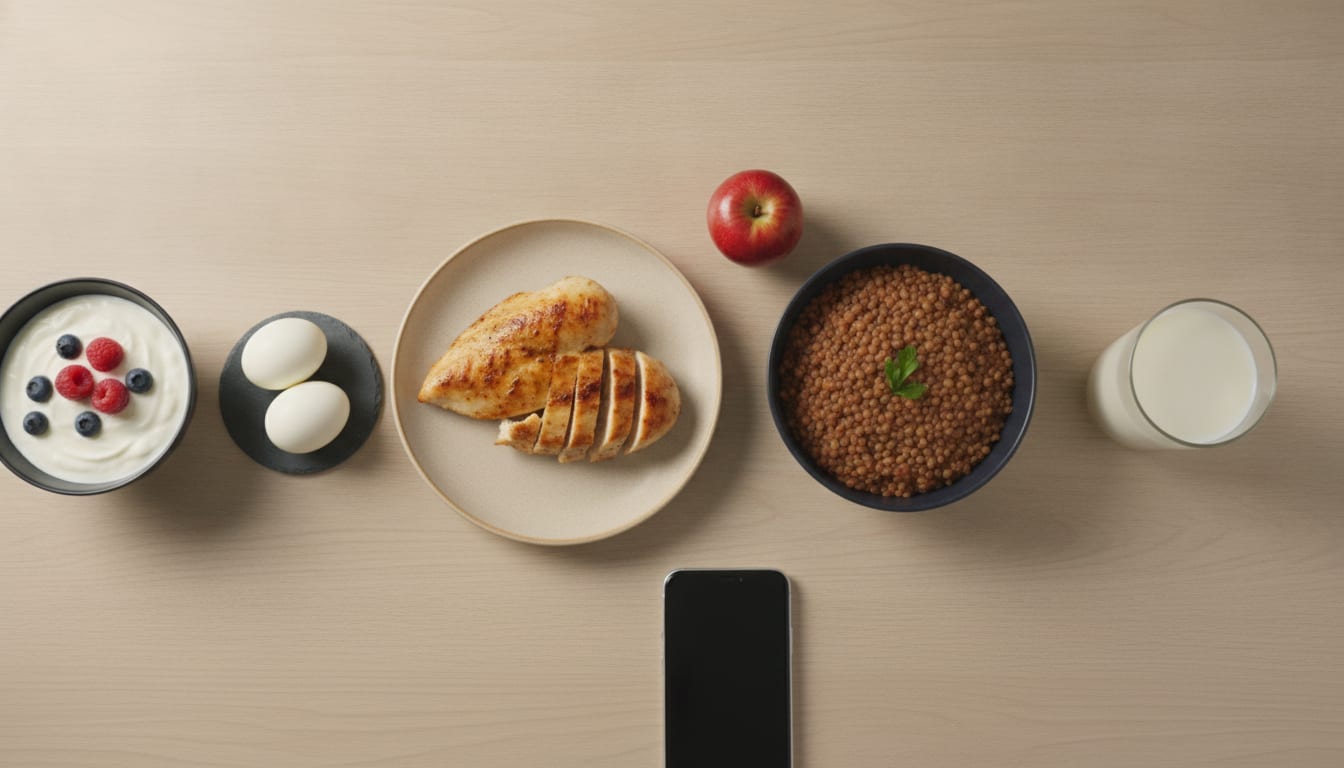
A useful reference point: a palm-sized portion of cooked meat or fish approximates 25 to 30 grams. Most people can construct a reasonably accurate day from that heuristic once they have calibrated it against a scale for a week.
Using a Tracker Well
Track for two to four weeks, not forever. Long enough to see your genuine pattern, including weekends, which usually differ substantially from weekdays.
Watch the weekly average, not the daily number. Day-to-day variation is noise. The average over a week is the quantity that relates to outcomes.
Check your distribution, not only your total. If your app separates meals, look at the split. A back-loaded day with an adequate total still leaves improvement available.
Weigh food for the first week. Portion estimation is the largest source of error, and a week with a kitchen scale corrects it more effectively than any other intervention.
Set a target you can actually reach. An unreachable target produces a permanently unclosed ring and, shortly afterwards, an uninstalled app. Set something you hit four days in five, then raise it.
Stop when you have learned what you needed. Return for a week whenever your diet, training, or body weight changes meaningfully. Continuous tracking is not required and, for some people, is actively counterproductive.
A note on that last point: for anyone with a history of disordered eating, food logging can be harmful, and the potential benefits described here do not outweigh that risk. Work with a registered dietitian rather than an app.
Frequently Asked Questions
Is 0.8 grams per kilogram enough protein?
It is enough to prevent deficiency in a healthy sedentary adult, which is what the RDA was designed to establish. It is not the intake associated with optimal muscle mass, satiety, or preservation of lean tissue with age. People who train, people losing weight, and adults over roughly 65 all have good evidence supporting higher intakes.
Can eating too much protein damage your kidneys?
In people with normal kidney function, the evidence that high protein intake causes kidney damage is weak; controlled trials at intakes well above the RDA have not demonstrated harm. This does not apply to people with existing kidney disease, for whom protein restriction is often part of clinical management. Anyone with kidney or liver disease should get their target from a physician.
Does the body waste protein above 30 grams per meal?
No, though the idea is widespread. Absorption is not the limiting factor — the digestive tract handles far more than 30 grams. What saturates is the muscle protein synthetic response, which plateaus at roughly 0.4 g/kg per meal. Protein beyond that point is still absorbed and used for other purposes; it simply contributes less to muscle building than the same protein eaten at a separate meal.
Do vegetarians and vegans need more protein?
Somewhat. Lower digestibility and less complete amino acid profiles in most plant sources mean a modest upward adjustment of roughly 10 to 20 percent is reasonable. Combining complementary sources within a single meal is unnecessary; variety across the day is sufficient.
How long does it take to see results from higher protein intake?
Effects on satiety and appetite are often noticed within one to two weeks. Changes in body composition require considerably longer — meaningful changes in lean mass typically take eight to twelve weeks of consistent intake combined with resistance training, and are not visible on a bathroom scale.
Do I need protein powder?
No. Protein powder is a convenience, not a requirement, and offers no advantage over whole food beyond speed and portability. It is useful for people who struggle to reach their target from food alone, particularly around training or on busy days. Whole foods bring micronutrients and fibre that powders do not.
Try Protein Tracker
Protein Tracker turns the guidance above into a single number you can check. Answer a few questions about your body weight, activity level, and goal to get a personalised daily target, then log meals from a database of over 100 high-protein foods in seconds. The daily ring shows grams remaining, the meal breakdown reveals your distribution, and weekly stats show the average that actually matters.
The free tier includes one protein log per day. Pro adds unlimited logging, AI Meal Scan, custom foods, and editing of past entries, available weekly or as a one-time lifetime purchase.
Your logs stay on your device by default.